


Binance has experienced $4.7 billion in net outflows since the crypto-exchange giant reinstated withdrawals following a historic hack, a figure that’s grown but is still a small portion of overall assets on the platform.
The net outflows — which factor in withdrawals as well as deposits — now represent about 3% of total assets under management, a spokesperson said on Monday. All of the figures have shifted since Binance restored customers’ ability to retrieve their funds, but the damage still appears to be relatively contained.
Withdrawals have stayed within the exchange’s expectations, while deposits have been “steadily increasing,” the spokesperson said.
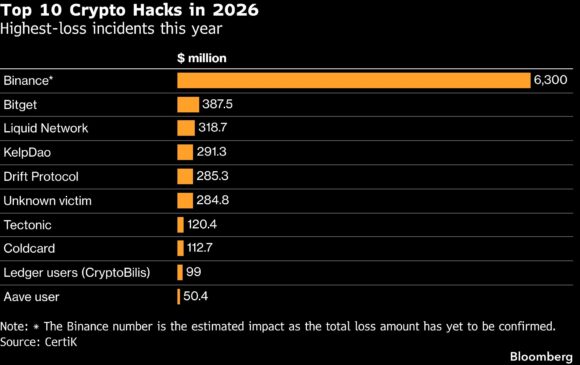
Traders and market-makers have been expressing a similar view, surprised at the speed with which Binance got ahold of the unprecedented cybertheft, which has been attributed to North Korea. It resulted in $6.3 billion of assets being drained in a blink, as exchange executives liaised with industry partners and government agencies to freeze activity and investigate.
Read more: Record Binance Hack Shows No Crypto Firm Is Too Big to Breach
Binance restored customers’ access ahead of schedule on Sunday and has been using a mixture of its own profits, as well as emergency and insurance funds to make customers whole.
The way Binance has so far absorbed the hit is “absolutely mind-blowing,” said Karl-Martin Ahrend, co-founder at Areta, an advisory firm focused on digital assets. Some outflows and rebalancing from traders is “absolutely expected,” he said, but he doesn’t foresee longer-term impact.
The broader digital-asset market has remained relatively steady in the wake of the incident. Industry bellwether Bitcoin was little changed, trading at around $77,830 on Monday morning in New York hours.
Traders’ faith in Binance stems partly from an assessment that its balance sheet is large enough to withstand a hack of this scale.
As of Monday, Binance held $157 billion in assets, the spokesperson said, citing internal estimates that factor in the impact of hack, subsequent withdrawals and price fluctuations. Not all the withdrawals are necessarily from customers, as Binance has also been transferring assets between wallets, Binance Co-Chief Executive Officer Yi He earlier said.
Although $4.7 billion in net outflows is a large figure, it is still a small portion of Binance’s overall reach, experts said. Similarly, the $6.3 billion theft can seem manageable in context. Binance’s gross revenues appear to be about $10 billion to $20 billion a year, based on the fees and volumes it makes public, as well as executive statements, said Joshua Lim, co-head of markets at FalconX.
“While this loss is damaging for the reputation of the industry, we believe Binance has the financial strength to resume operations normally,” he said.
And, as the world’s biggest liquidity venue, counterparties say they have little choice but to still trade there.
Julia Zhou, president and co-founder of crypto market-maker Caladan, pointed to the second-largest hack in crypto history for context. Bybit last year lost roughly $1.5 billion to an exploit that the Federal Bureau of Investigation linked to North Korea, as it has done with Binance’s. The Bybit incident was followed by a rush to withdraw funds, but the redemptions eventually stabilized.
“From a market-making perspective, we’re also looking at net flows, whether deposits return, how trading liquidity and market depth hold up, and whether funds are moving to other venues,” Zhou said. “Ultimately, the bigger test is whether Binance can maintain normal trading conditions.”
Cybercrime Surge
The crypto market at large has faced a surge in cybercrime this year, fueled in part by the growing sophistication and availability of artificial intelligence tools. The North Korean group called “TraderTraitor,” which the FBI blamed for the Binance heist, may be just another example.
Read More: North Korea’s Hackers Supercharge Crypto Heists With AI Skills
The spate of hacks has exposed mainstream crypto platforms — and even hardware wallets, long considered the safest way to hold tokens — as not quite as safe as customers believed. Hundreds of millions of dollars were drained from Bitget in September, after hackers stole more than $100 million in Bitcoin from wallets secured by physical Coinkite Inc. devices. Tampering involving similar Ledger devices also led to millions of dollars in losses.
The average crypto holder “may feel a bit stuck,” said Nick Smart, chief intelligence officer at crypto analytics platform Crystal Intelligence. However, “Binance remains the dominant exchange platform despite the outflows. So even if the venue is shaken, it’s far from lost.”
Related:
Topics Cyber
Was this article valuable?
Here are more articles you may enjoy.
 Private Jet’s Pilot Reported Turbulence Before Florida Crash
 Binance’s $6.3 Billion Hack: How Crypto Insurance Works
 PHP Security Flaws Highlight Potential Systemic Risk Aggregation for Cyber Insurers
 Trucking Companies Confront Mounting Diesel, Insurance, Debt Costs


